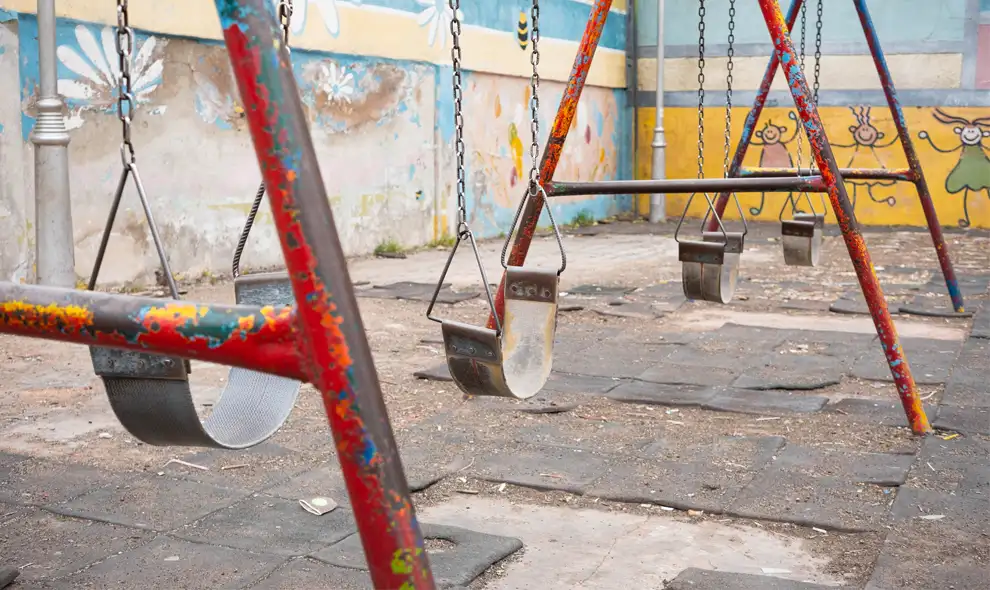
Many professionals in the flooring industry, parents included, are not aware of the minimum playground safety standards and legal requirements in South Africa.
Playground owners beware!
It is estimated that there are approximately 40 000 injuries to children on playgrounds each year that result in hospital visits. The legal ramifications if a child gets injured, maimed or even die in a playground range from penalties for non-compliance to jail time.
Jeremy Stewart, chairman of the South African Sports and Play Industry (SASPI), confirms: “The need for safe play areas in cities has never been greater. The law protects children against careless and non-compliant play surfaces.”
SASPI
SASPI is the responsible party for playground flooring legislation and compliance. It strives to foster excellence in quality, standards and ethical practices within the sport and playground surfaces industry.
According to SASPI, playground injuries are concerning, with over 200 000 children under 14 receiving medical treatment for such incidents annually. The organisation therefore aims to ensure children’s playgrounds have SANS-certified rubber surfacing, providing a safe and enjoyable environment for children to play in.
It promotes adherence to safety standards to prevent severe injuries and ensure responsible management of recreational spaces, thus promoting a safer environment for children to play.
There is a legal and moral responsibility to ensure that the flooring installed under and around play structures offers significant protection to a falling child.
Whilst the implementation of playground safety standards internationally has proven to reduce accidents and deaths by as much as 80%, many local playgrounds are still not compliant. This is despite the fact that failing to install suitable rubber safety surfacing at the correct legally certified thickness in a playground can lead to hefty fines.
Statistics show that injuries, which occur during play and leisure activities, account for 36% of non-fatal home and leisure accidents. “This cannot be ignored, and the local built environment really needs to pay heed to the reality of serious injuries and deaths on playgrounds in South Africa,” says Stewart.
Children’s playgrounds must have SANS-certified rubber surfacing, providing a safe and enjoyable environment for children to play in.
Local Legislation
Locally, two South African National Standards (SANS) apply:
- SANS 51176: The purpose of SANS 51176 is to ensure a proper level of safety when playing in, on or around playground equipment, and at the same time to promote activities and features known to benefit children because they provide valuable experiences that will enable them to cope with situations outside the playground.
- SANS 51177: The South African Standard (SANS 51177:2010) for critical fall height is a direct adoption of the international EN Standard 1177:2008. The critical fall height is defined as the lowest fall height that generates a head injury criterion (HIC) value of 1 000.
This is a minimum standard imposed by the “Duty of Care” application of the law, which applies to the following:
- Public playgrounds. Schools.
- Municipalities. Entertainment centres. Nursery schools.Where a third party is involved, regardless of whether there is supervision.
Common accidents and causes
The accident statistics show that playground accidents occur for several reasons:
Management
- Poor equipment design or failure to comply with safety standards.
- Poor design and layout.
- Incorrectly specified or installed safety surfacing.
- Unsuitable equipment for the intended age group.
- Incorrect installation. Poor or non-inspection. Poor maintenance.
User causes
- Lack of supervision.
- “Misuse” of equipment.
- Unsuitable clothing worn.
- Weather conditions.
That said, not all accidents are related to the equipment- perhaps only 40%, and of these, 80% result in a fall to the surface.
Playground safety requirements
The installation of a rubber mat, or artificial turf, is insufficient to achieve the required “Duty of Care” application of the law. “There are no shortcuts or cheap substitutions when protecting children. A playground must have an approved protection covering, with proper substrate preparation,” Stewart confirms.
Surfaces that do not comply with the Act are grass, artificial grass with or without sand, cement/clay pavers, tar surfacing, plain natural surfaces such as ground and soil.
Substrate design
As with most flooring, installing impact surface coverings requires a suitable substrate. Consideration should be given to the following:
- Substrates must be solid, free of cracks, clean and dry, and free of oil or other foreign materials.
- Friable or absorbent substrates may require a primer to reduce adhesive absorption and to enhance bonding between the substrate and covering.
- The surface must provide sufficient drainage. Adjacent paved surfaces must be level with a slope of roughly 2%, with adequate run-off drains.
- Any depressions in the substrate must be filled and levelled with a suitable material to ensure a smooth, level surface.
- Where the substrate comprises compacted stone, ensure each layer is compacted with a vibration compactor, and uneven spots are corrected with suitable material.
- Regardless of the type of subsurface used, it must not deviate from level by more than 5mm under a 3m straight edge.
- Wet-pour flooring can be applied over existing floors if there is no movement and/or no structural faults exist.
Safe surfaces
Impact protection surfacing includes both impact protection slabs and wet-pour products. These must be installed over the impact area beneath all playground equipment with:
- A free-fall height of more than 60cm.
- Equipment causing a forced movement on the body of the user.
This includes swings, slides, rocking equipment, cableways and carousels. The installed thicknesses of these surfaces correlate to different critical fall heights. Effectively, the higher the fall, the thicker the slab needs to be.
The proper placement of playground flooring is also essential, regardless of the type of surfacing:
- Protective surfacing should be extended to at least two metres from the outside of the equipment in all directions.
- The impact protection flooring should extend in front of and behind a single-axis swing, to a distance that is equal to the height of the top bar from which the swing is suspended.
Surfacing should cover a radius that is equal to the height of the suspending chain or rope plus two metres in all directions, for round or multi-axis swings.
Installation matters
The Code of Practice (COP) for the Installation and Maintenance of Wet-pour Safer Surfacing for Playgrounds is the current National SASPI standard and it is being converted into the official SANS standard. Training in this COP is currently available through Seamless Flooring Systems.
Designing and specifying playground surfacing involves many factors. Failing to address the requirements allows room for a child to be gravely injured. When in doubt, consult a specialist for advice.
The international measure for the likelihood of a head injury arising from an impact is calculated using an HIC meter. This equipment consists of a metal sphere resembling a dummy head, which is fitted with various certified acceleration sensors.
By dropping the sphere on the floor from various heights, it is possible to determine the fall height at which the fall surface has a sufficient impact absorbing value. This HIC value is calculated by measuring acceleration during a fall and measuring the impact when the sphere hits the ground. The lower the HIC value, the higher the protection for the child’s head.
For impact protection materials on playgrounds, the maximum HIC value is 1 000. At this measurement point, there is a 90% probability of a moderate head injury to the average adult. This upper limit ensures that virtually no head injuries with permanent damage can be expected.
For more information, contact SASPI or Seamless Flooring Systems or head over to our contact page