Introduction
After many years of involvement in the playground safety surfacing industry, we have made the strategic decision to no longer distribute or specify rubber playground tiles in South Africa. Our experience with rubber playground tiles South Africa has highlighted several technical, compliance, maintenance, and security concerns that have influenced this decision.
This decision is based on technical performance considerations, compliance concerns, long-term maintenance requirements, and the practical realities of the South African environment.
While rubber playground tiles were once considered a practical alternative for playground safety surfacing, our experience has shown that they present a number of challenges that can impact long-term safety, durability, maintenance costs, and overall lifecycle performance.
Challenges Facing Rubber Playground Tiles in South Africa
One of the primary concerns is the limited availability of locally manufactured playground rubber tiles that can demonstrate ongoing compliance with recognised playground impact attenuation standards.
For schools, developers, municipalities, and contractors, this creates challenges when specifying playground surfaces that must satisfy safety and performance requirements throughout the life of the installation.
The absence of widely available certified systems can make it difficult to verify whether a particular product will continue to meet the required critical fall height and impact attenuation performance expected within modern playground environments.
Are Playground Safety Mats the Same as Rubber Playground Tiles?
Rubber playground tiles are often referred to as safety mats, playground safety mats, or rubber playground mats. These products are designed to provide impact attenuation beneath playground equipment and are commonly used in schools, parks, and recreational facilities.
While safety mats can provide a degree of fall protection when correctly specified and installed, they remain subject to the same challenges associated with theft, movement, maintenance, and long-term performance. For this reason, many playground operators and specifiers are increasingly selecting seamless wet-pour surfacing systems as a more durable long-term solution.
Limited Availability of High-Performance Interlocking Tile Systems
South Africa currently has very few locally manufactured interlocking playground tile systems comparable to those commonly used in Europe and other international markets.
While imported rubber playground tiles can offer excellent performance, they often involve significant import costs, extended lead times, and substantial warehousing requirements. These factors can make large-scale projects financially challenging.
In addition, maintaining stock levels for multiple tile thicknesses, colours, and fall-height requirements often requires considerable investment and storage capacity.
Theft and Vandalism Remain a Major Concern
One of the most significant challenges facing rubber playground tiles in South Africa is theft and vandalism.
Because tiles are generally loose-laid or adhered to a prepared substrate, individual sections can often be removed relatively quickly. Unfortunately, theft of playground surfacing has become an increasing concern for schools, municipal parks, and public recreational facilities.
The replacement costs associated with stolen tiles can place considerable pressure on maintenance budgets and often result in extended periods where playgrounds remain partially unusable.
Ongoing Maintenance and Safety Challenges
Rubber playground tiles can also present maintenance challenges over time.
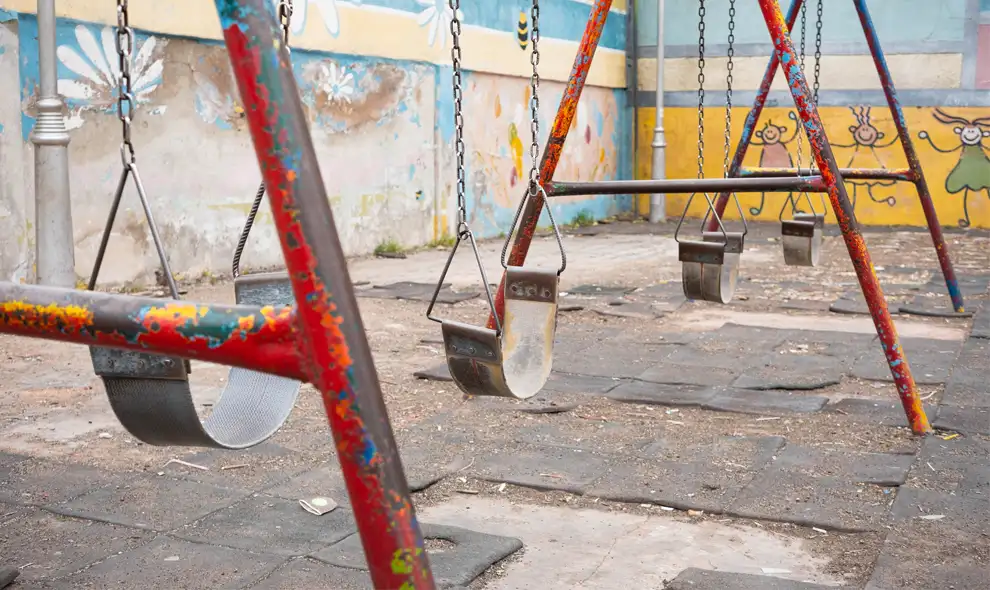
Movement between tiles may occur as surfaces age, potentially creating uneven joints and trip hazards. Edge lifting and curling can also develop under prolonged UV exposure, fluctuating temperatures, and heavy use.
Once individual tiles begin to move or deteriorate, the appearance and performance of the playground surface can be affected, often requiring ongoing maintenance or replacement.
Why Wet-Pour Surfacing Is Replacing Rubber Playground Tiles
Across South Africa and many international markets, wet-pour rubber surfacing has become the preferred playground safety surfacing system for schools, municipalities, landscape architects, developers, and contractors.
Unlike tile-based systems, wet-pour surfacing is installed as a seamless bonded surface. This reduces the risk of movement between sections, eliminates visible joints, and significantly reduces opportunities for theft and vandalism.
Modern wet-pour systems can also be engineered using dedicated shockpad layers and certified system build-ups to achieve specific critical fall height requirements while maintaining a seamless and attractive finished surface.
Additional advantages include:
- Seamless, continuous surface finish
- Excellent design flexibility and colour options
- Reduced trip hazards
- Long-term durability
- Easier integration with playground safety requirements
- Lower long-term maintenance requirements
- Resistance to theft and vandalism
A Long-Term Approach to Playground Safety Surfacing
For these reasons, we believe wet-pour playground surfacing remains the most practical and sustainable long-term solution for many South African playground environments.
While rubber playground tiles and playground safety mats may still be appropriate in certain specialised applications, our experience has shown that seamless wet-pour systems generally provide superior performance, durability, security, and lifecycle value.
When specifying playground safety surfacing, the objective should always be to achieve long-term safety, compliance, durability, and value rather than focusing solely on initial installation costs.
For more information on playground surfacing compliance, impact attenuation requirements, and engineered wet-pour surfacing systems, contact Seamless Flooring Systems or visit our Contact Page.
For more information, contact SASPI or Seamless Flooring Systems or head over to our contact page